
When the Levee Breaks
What if everyone could plan infrastructure?
Dec. 2, 2025 - Brett Sanders didn’t name his flood modeling company after a Led Zeppelin song by accident. “When the Levee Breaks” is more than a musical reference, it’s also a forecast.
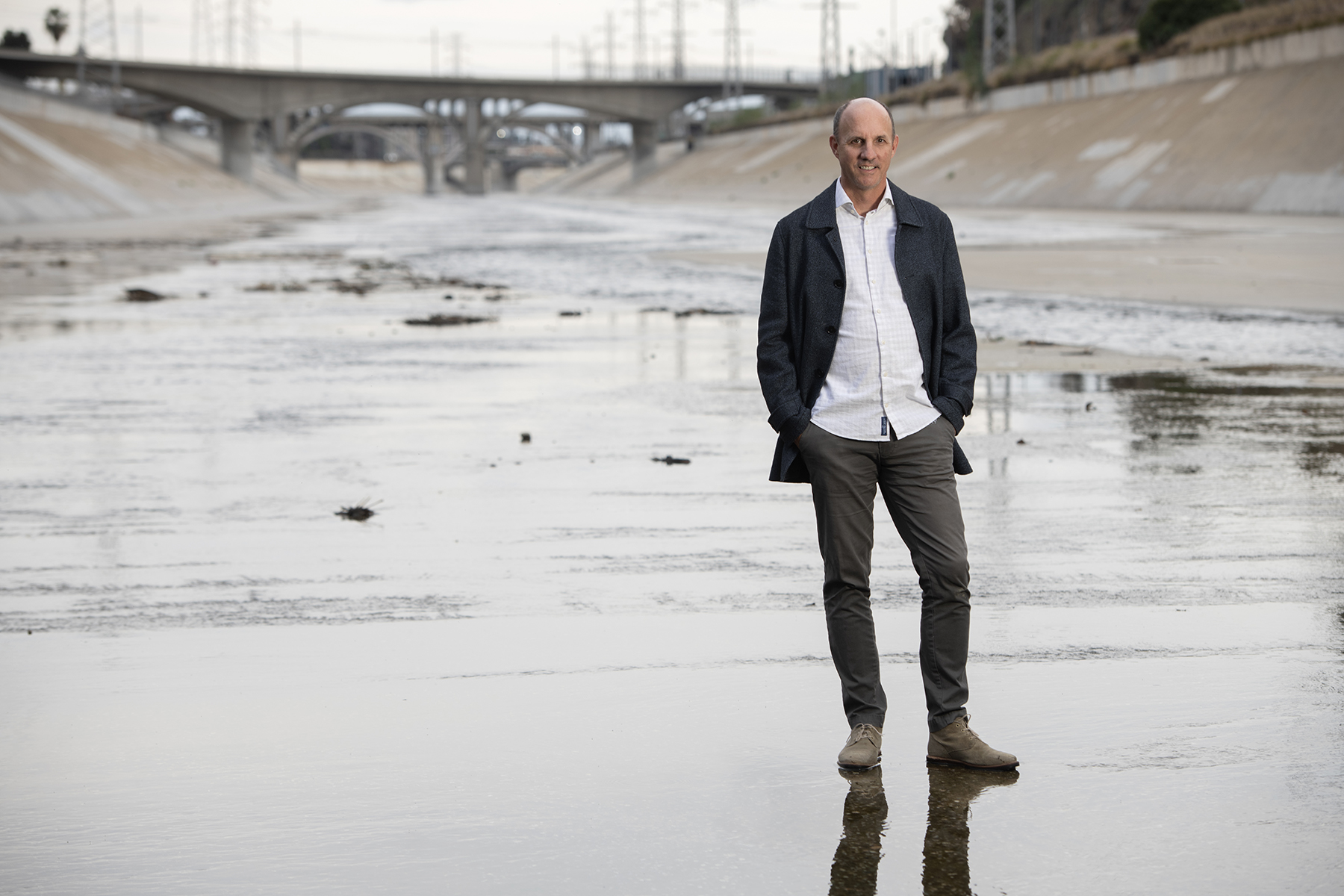
If it keeps on rainin’, levee’s goin’ to break… the lyrics say. It’s a warning that feels increasingly relevant as climate change amplifies the threat. Warmer oceans mean stronger hurricanes, rising seas mean more tidal flooding, and extreme rainfall events are straining stormwater infrastructure that was never designed for this kind of stress.
Even as the nature of flood threats has changed, the way we assess them has remained largely the same. In most places, risk is still framed in binary terms—either you’re in the flood zone, or you’re not. But that single line on a map is a potentially misleading tool.
That disconnect between how risk is communicated and how it’s experienced is where Zeppelin Floods, a climate tech startup from UC Irvine, sees a chance to fill a critical gap.
“Traditional flood maps create the false impression that you’re either at risk or you’re not. But flood losses happen on both sides of the line,” says Sanders, Chancellor’s Professor of Civil and Environmental Engineering. “These maps were created to manage insurance, not to communicate risk.”
Zeppelin Floods builds fast, high-resolution flood simulation software that can model water movement through urban environments in real time and with building-level precision. Originally developed in Sanders’ lab with two of his former Ph.D. students, Jochen Schubert and Adam Luke, the software uses advanced computational methods to simulate how storms, tides, sea-level rise, or river surges might interact with infrastructure like roads, levees, or drainage systems.
But flood modeling, in Sanders’s view, doesn’t have to be limited to experts. It has the potential to evolve into a civic tool that communities might use to plan and prepare. That same idea animates his work at UC Irvine, where he’s focused on breaking down the silos between disciplines, connecting researchers to policymakers, and potentially bringing the public into the planning process.
A Problem Hiding in Plain Sight
The standard source of flood risk information in the U.S. is the flood zone maps produced by the Federal Emergency Management Agency (FEMA). Designed primarily to administer the National Flood Insurance Program, these maps outline areas with a 1% or higher chance of flooding in any given year, or what’s commonly referred to as a “100-year flood zone.” But these maps don’t include flood depth or probabilities, and, in many areas, they haven’t been updated in years. Homes just beyond the official flood zone may be just as vulnerable, yet they’re often overlooked by insurance pricing and resilience planning.
As flood risks grow more severe and less predictable, the private sector has taken notice. Over the past several years, a climate risk analytics industry has emerged to serve insurers, investment firms, and financial institutions looking to understand exposure to extreme weather events. But as that industry has grown, Sanders noticed a recurring pattern: many of these tools favored scale over specificity.
“We were seeing a lot of models that worked globally, but they weren’t accurately capturing what was happening on the ground,” he says.
Zeppelin’s software is much more granular. It provides flood information on a street-by-street and structure-by-structure basis. It includes data on local drainage systems and topography. It’s been tested and validated with real-world flooding events. In cities like Los Angeles, Miami, and Houston, Zeppelin’s models have produced more detailed, and more accurate, predictions than industry-standard tools.
In short: if you want to know how flooding will affect your neighborhood, your street corner, or your home, Zeppelin Floods might be your best bet.
A Model of Collaboration
Underlying Zeppelin’s approach is a larger philosophical shift. Rather than seeing flood modeling as something only for the federal government or specialized firms, Sanders imagines it as something that can be integrated into the civic process. His team is working on tools that would allow local governments and community organizations to simulate flooding scenarios and see for themselves how the landscape shifts.
Zeppelin’s modeling tools aren’t just about showing damage; they also model how specific interventions might reduce it. Users can explore what would happen if green roofs were added, a flood channel widened, or a park regraded to capture more stormwater. In a current National Science Foundation (NSF)-funded project in Miami, Sanders’s team is working with local officials and residents to test scenarios in real time. Stakeholders can propose ideas and immediately see how those changes affect flood depths or water flow.
This approach informs the design, but just as importantly, it builds trust.
“People feel heard when they can offer a solution and see how it plays out.”
“People feel heard when they can offer a solution and see how it plays out,” Sanders says. “Even when their proposed idea falls short, they’re invested in the final plan because they were part of the process.”
That belief in shared problem-solving extends to Sanders’ work on campus, too. At UC Irvine, he leads the UC Irvine Campus Climate Collaboration, a faculty-driven initiative designed to elevate the university’s impact in the climate space by encouraging partnerships across disciplines, schools, and sectors.
“As faculty and researchers, we can have real impact by working across disciplines and partnering with agencies, community groups, and government—and by making sure we’re including students in the process of solving real-world problems,” he says.
Turning that vision into a viable company required more than technical know-how. It needed a way to connect academic research to practical, commercial use. That bridge came through UC Irvine Beall Applied Innovation’s Proof of Product (PoP) grants and the NSF’s I-Corps program, both of which support university researchers in exploring commercial potential.
“Those programs fundamentally changed how we approached our work,” Sanders says. “They gave us the structure and momentum to move from research to real-world application, and to connect with the people who would actually benefit from our work.”
From Data to Design
That experience would go on to shape Zeppelin’s evolution. Sanders originally imagined that Zeppelin would become a data product company. And while the team has delivered custom modeling for agencies like the Irvine Ranch Water District, the City of Newport Beach, and cross-border projects near San Diego, the hurdle, he says, was scale. The customers with the biggest potential (insurance firms and institutional investors) need nationwide or even global data coverage. Zeppelin’s models, while precise, are expensive to build city by city. They haven’t yet had the resources to achieve that kind of spatial reach.
Instead, the startup has gained traction in the consulting space, offering modeling to urban planners, engineers, and municipalities looking to evaluate flood mitigation projects. Sanders believes that this is the path forward.
He points to an emerging partnership with Arup, the global design and engineering firm known for its sustainable infrastructure work. The two teams are exploring how Zeppelin’s modeling engine can support green infrastructure design in dense urban environments. At Climate Week in New York City in September, Arup demoed a model of Manhattan using Zeppelin’s software to evaluate how investments in green roofs might reduce flooding.
Before the Water Comes
By broadening access to flood modeling, Zeppelin Floods is shifting the conversation around who gets to shape the future of climate resilience. As climate risk becomes more immediate, and as infrastructure debates become more fraught, Sanders believes the tools we use to plan for those risks need to be both more powerful and more widely shared.
“You’ve got to talk to people early on,” he says. “Not just about the flooding they’re seeing today, but what kind of investments they want to see in their community in the future.”
Which brings us back to the name. Long before Led Zeppelin made it famous, “When the Levee Breaks” was written in response to the Great Mississippi Flood of 1927, one of the most destructive natural disasters in United States history.
Cryin’ won’t help you, prayin’ won’t do you no good, the song says. When the levee breaks, mama, you got to move.
The lyrics also serve as a call to action, a reminder that the water’s coming. Zeppelin Floods is trying to make sure we’re ready.
- Jill Kato
