
Inspirations from Nature: UCI Robot Ecology Lab
The Lab Beat
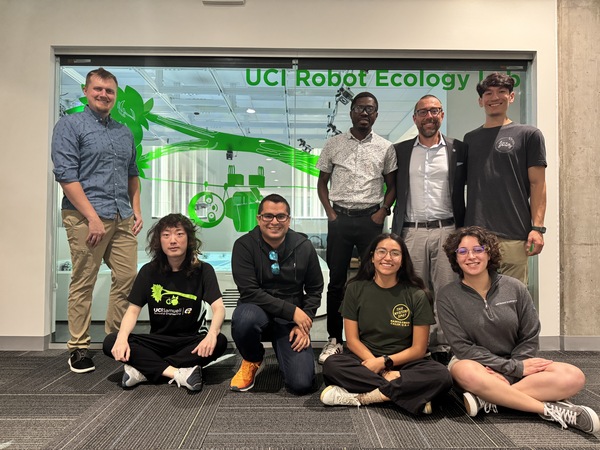
Dec. 2, 2025 – If you visit the UCI Robot Ecology Lab, you’ll see swarm robots being kind to one another and environmental robots modeled after cute animals like the RaccoonBot and SlothBot. These are all the brainchild of Magnus Egerstedt, a top roboticist, professor of electrical engineering and computer science, and the dean of the UCI Samueli School of Engineering.
Egerstedt and hist team are dedicated to creating altruistic robots. They get their inspirations from nature. “I’ve always found fascinating, even as a kid, how schooling fish and flocking birds move together,” said Egerstedt. That curiosity led him to establish the Robotarium, the first remotely accessible lab for swarm robots that’s been used by over 7,000 researchers.
“Swarm robotics is ultimately about how you take simple things like a robot that has very limited information and can’t see very far and have that robot work together with 100 of its closest robot friends,” he said. “All of a sudden these beautiful structures and geometries emerge as robots form shapes by working together.”
UCI researchers are testing algorithms to see if robots can be organically kind and helpful to one another as they move about on their assignments. “We want robots to think about not just their own tasks, but also the task of their neighbor, or take on additional cost to benefit another robot's task,” said postdoctoral engineering researcher Brooks Butler. The lab has seen this altruistic behavior demonstrated when robots act kindly without being told exactly what to do. If they’re about to bump into each other, for example, instead of moving backward, the robots pause and yield like a human to find the best way to help each other get where they need to go.
Some robots are even willing to risk their lives (which means run out of batteries) to help other robots as they map an environment together. “We have a robot that's willing to risk its life to see what's out there to give information to another robot,” said electrical engineering Ph.D. student Diana Morales. “They can go a lot further if they help each other out.”
To Egerstedt, robotics is an exploration of nature and the human mind. Before he became a top roboticist, he earned a degree in philosophy and linguistics from Stockholm University, so he approaches robotics like applied philosophy. “I really wanted to get at deep questions about humanity by building machines,” he said.
“Nature is this endless source of inspiration,” he said. “I took the environmental monitoring route with my robots because I wanted to make sure I made robots that contribute to the good of the world in some small way.”
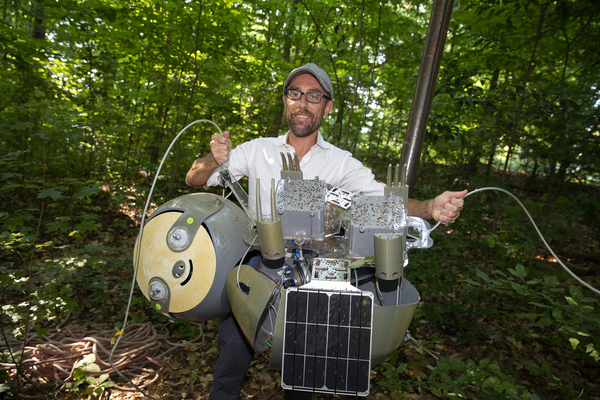
The SlothBot was born after Egerstedt observed sloths in the wild during a vacation in Costa Rica. “They are so energy efficient. They live off what would be like a human living off a fraction of a small bag of potato chips,” he said. The hyper energy efficient SlothBot hangs out under tree canopies, collecting data for conservation research at Atlanta Botanical Garden. When it’s running low on solar energy, it just moves along the wire to a sunny spot to sunbathe and recharge.
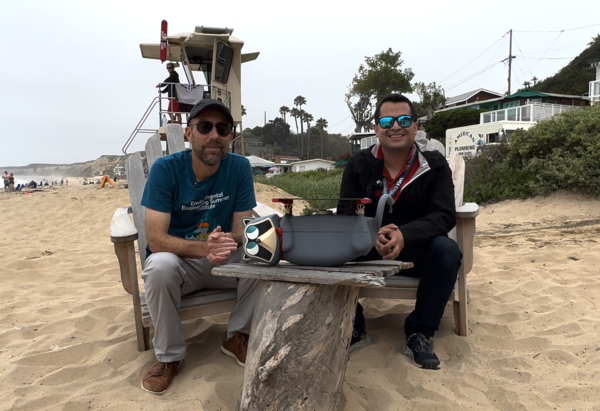
At UCI, Dean Egerstedt partnered with Crystal Cove State Park to have a robot installed at the state beach. Since sloths don’t live in California, they wanted to model it after an animal indigenous to the Golden State. “I was actually down at one of our local beaches and saw a raccoon digging through a trash can so we decided to turn it into a raccoon instead,” Egerstedt said. Now the RaccoonBot hangs on a wire near the entrance to the state park, greeting visitors and measuring the microclimate at the popular destination.
Next, the lab is partnering with the Ocean Institute and UCI professor of civil and environmental engineering Mo Li to create an OtterBot to go down into the ocean at Dana Point. The new robot will travel up and down a wire anchored by a buoy in the water to measure ocean data.
The UCI Robot Ecology Lab is doing well in its mission to create robots that do good in the world. As a philosopher-turned-roboticist, does Dean Egerstedt have a dream robot? “I ultimately want to understand the human mind, and I think robotics is a way of helping us do that,” he said. “I don't know what the robot looks like, but my dream robot is one that unlocks the mystery of the human mind, which is such a remarkable organ.”
- Natalie Tso
(Listen to a 7-minute podcast featuring Magnus Egerstedt and the UCI Robot Ecology Lab on The Lab Beat)
