
Fueling the Future with Hydrogen
The Lab Beat
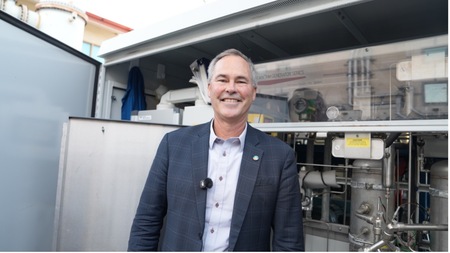
Jan. 6, 2026 - Jack Brouwer, the director of the UCI Clean Energy Institute, has been fascinated with the energy that powers vehicles ever since he was a boy on his family’s farm. At age 11, he was driving the tractor, and by 15, he was tuning his car for better performance and fewer emissions. Now, he’s leading the energy institute that’s creating sustainable hydrocarbon fuels to power airplanes and ships – fuels that could change the world.
Brouwer is working with Chevron to co-electrolyze carbon dioxide and water streams to make a synthesis gas, made of carbon monoxide and hydrogen, that’s a prerequisite for making liquid hydrocarbon fuel. If this technology succeeds, it could revolutionize the oil industry. “I'm excited to work with Chevron on this because I think that major oil companies can eventually transform all of their fossil-based technologies into renewable and sustainable hydrocarbon (e.g., aviation fuel, chemicals) production technologies,” said Brouwer. That shift would completely change the world’s energy map.
The institute is also working with the University of Naples, Parthenope to develop sustainable fuel for the shipping industry. “This includes not just hydrogen, which could be used directly, and we've evaluated that,” he said, “but we're also looking at how to make and use synthetic ammonia or synthetic methanol as a ship fuel.”
UCI has played a key role in the development of hydrogen and fuel cell technology from the start. In 2003, it launched America’s first public hydrogen fueling station, which provided the infrastructure for companies like Toyota, Honda, General Motors and Hyundai to deploy their fuel cell vehicles. UCI did the same for battery electric vehicles and was the first university in the nation to convert its buses to an all-electric fleet.

“It's one of the reasons why the state of California is really leading in deploying fuel cell and battery electric vehicles,” said Brouwer who is also a UCI professor and Chancellor's Fellow of mechanical and aerospace engineering. “We contributed to that introduction.” Two alumni, Tim Brown and Shane Stephens, who received their engineering PhDs at UCI, founded First Element Fuel, which builds and runs most of America’s hydrogen fueling stations.
The world can’t rely on fossil fuels indefinitely. Brouwer believes that hydrogen features are required for the ultimate set of solutions to the world’s energy needs. Hydrogen is lightweight, storable, transportable, available almost everywhere, and can be created and converted with zero emissions. These qualities make it suitable to power aircraft, ships and trucks.
When sustainable hydrocarbon fuels are developed, it will have a huge impact on the global economy and geopolitics. “Hydrogen is more equitably available,” Brouwer said. “Why do we fight wars over energy? Because some people have it and some people don't. If we create a means by which energy conversion, energy storage and delivering energy to people can be made everywhere, we won't have as many wars.”
That vision for more peace and equity is driving Brouwer’s pursuit of hydrogen energy. In his spare time, Brouwer is a Christian pastor, and approaches his clean energy research with that same altruistic zeal. “My ultimate vision is that there would be much less division amongst us, and that we would enable a sustainable future,” he said. “I want to enable energy conversion to be something that brings us together rather than separates us and leads to war.”
- Natalie Tso
(Listen to an 8-minute episode of The Lab Beat featuring Jack Brouwer)
