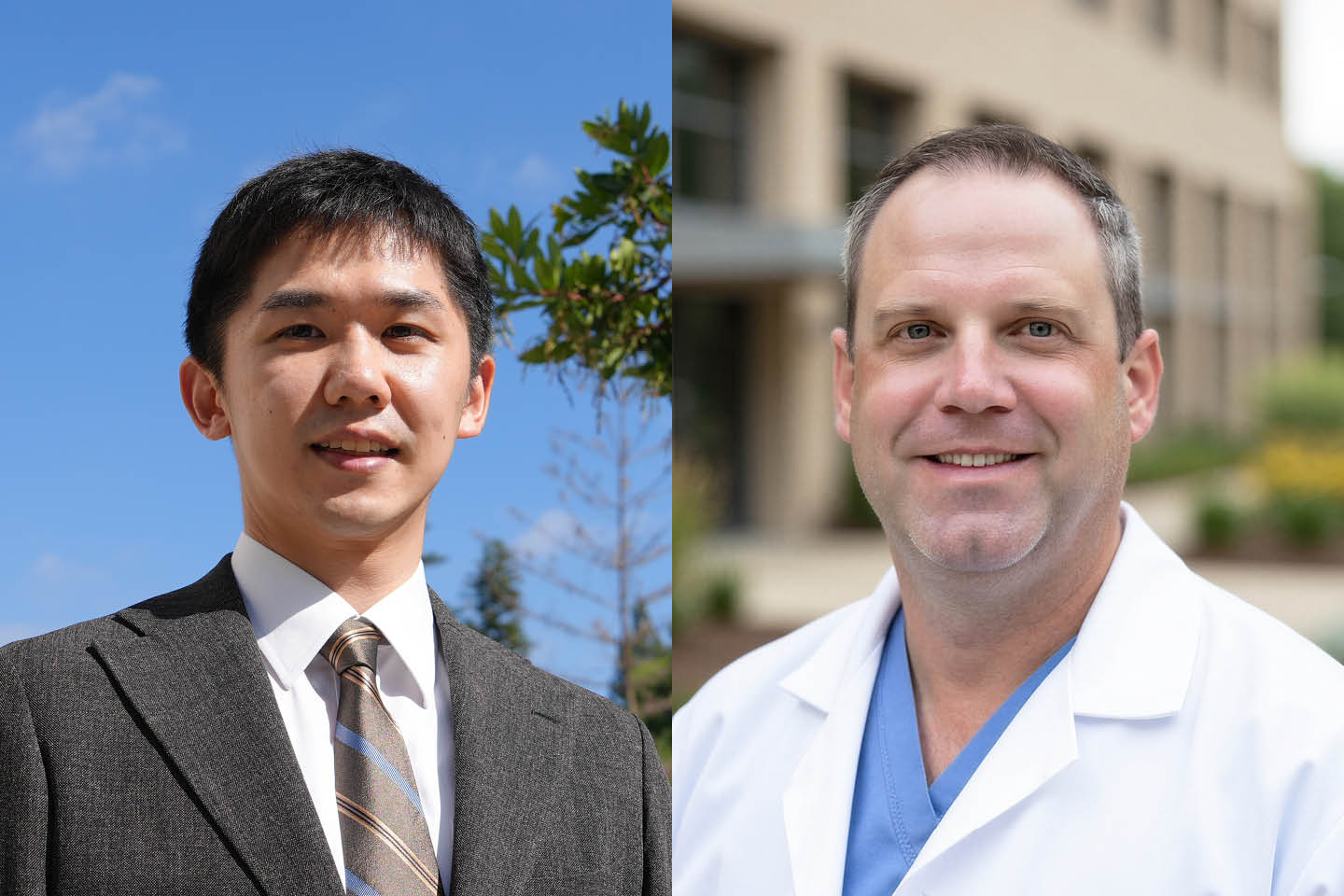
The UC Irvine Samueli School of Engineering — consistently ranked among the nation's top public engineering programs and home to members of the National Academies of Engineering, Science, and Medicine — welcomes two faculty members to its ranks for the 2025-26 academic year.
Blaine A. Christiansen and Yu Otsuki bring distinguished research portfolios, interdisciplinary expertise and a commitment to solving real-world problems through engineering innovation. Their arrivals strengthen UCI’s mission to advance discovery, cultivate the next generation of engineers and deliver meaningful impact to society.
Blaine A. Christiansen
Blaine A. Christiansen joins UCI as a professor in the Departments of Orthopedic Surgery
and Biomedical Engineering. He comes from UC Davis Department of Orthopaedic Surgery,
where his research program focused on bone biomechanics and musculoskeletal health.
His work examines how mechanical forces, biological factors, injury and aging interact
to influence musculoskeletal tissue health and lead to diseases such as osteoporosis
and osteoarthritis.
Christiansen's lab employs in vivo mouse models, mechanical testing and advanced imaging
techniques to understand musculoskeletal adaptation and degeneration at multiple scales.
His findings have helped shape the field's understanding of how acute injuries can
lead to degeneration of musculoskeletal tissues and how this can be mitigated.
“Working closely with biomedical engineers alongside the outstanding clinicians at
UCI Health is a unique opportunity to move discoveries from the lab setting toward
real world implementation in human patients,” he said. “I'm excited to leverage UCI's
advanced imaging capabilities and cutting edge research centers, which will complement
my lab’s imaging and mechanical testing capabilities to allow us to investigate research
questions from unique perspectives."
Yu Otsuki
Yu Otsuki joins UCI as an assistant professor in the Department of Civil and Environmental
Engineering. He joins after three years working in industry, where he developed a
research program bringing together robotics, autonomous systems, and civil infrastructure.
His work explores how intelligent robotic systems can transform construction processes.
Otsuki's lab uses robotic platforms ranging from wheeled robots, quadrupeds and manipulators
to humanoids and construction machinery, together with advanced computational and
programming methods, to advance the frontiers of construction technology. His prior
academic research included the development of a magnet-wheeled robot capable of performing
ultrasonic thickness measurements on steel bridge members, as well as theoretical
and computational advances in finite element modeling that sharpen the accuracy of
structural digital twins. In industry, he worked on off-road autonomous systems for
construction machinery and earthmoving operations.
"The Center for Resilient Autonomous Systems gives our work an immediate home and
connects us to the kind of interdisciplinary expertise that construction robotics
demands," he said. "Southern California's thriving construction industry also puts
us close to the industry partners who can help move this research from the lab onto
real job sites."
- Paul McQuiston