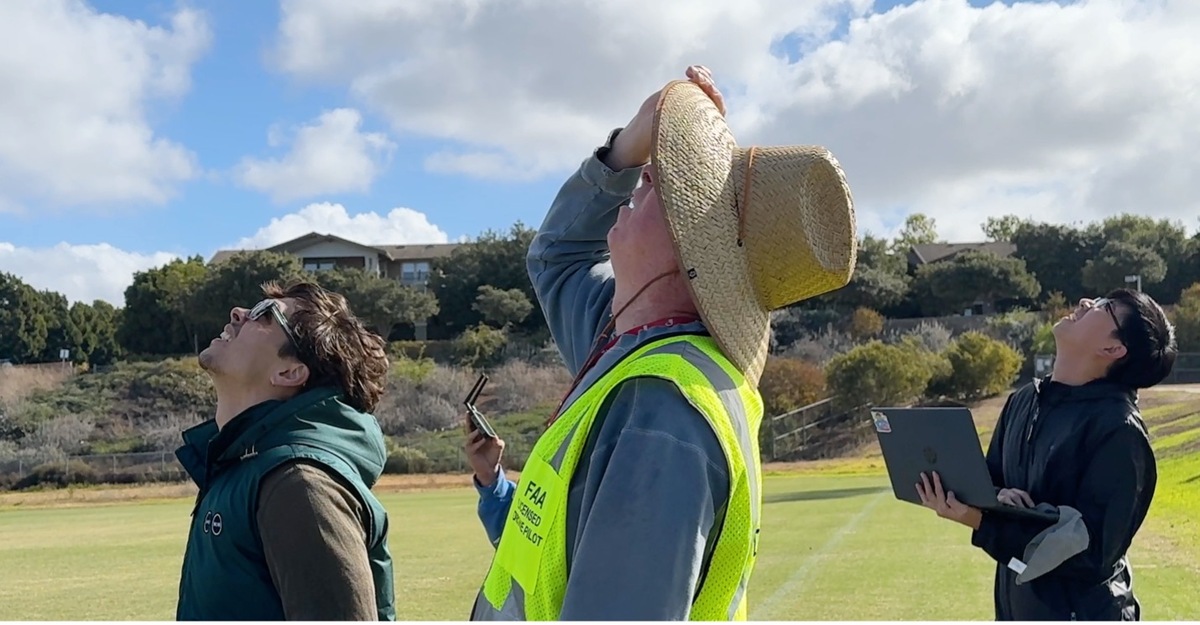
With a father in the Air Force, Peter Burke grew up watching planes and aspiring to be a pilot. “I was too tall. Pilots have to fit in the cockpit and my vision wasn’t good enough,” said Burke who is 6 foot 2 and wears glasses. Instead, Burke became an electrical engineering and computer science professor and is now creating cutting-edge drone technology at UC Irvine.
“I always wondered why airplanes couldn’t be remote controlled,” said Burke. When drones came out, he began building them in his garage. In 2022, he won the Guinness World Record for farthest distance to control a drone , which he managed by partnering with a student 11,440 miles away on Réunion, a tiny island in the Indian Ocean. He enabled the drone to be controlled by the student over the internet as it flew in a cage at UCI.
Now Burke and his students are linking drones to AI. “We’re pushing the boundaries of how to integrate the drones with AI,” Burke said. “What we've demonstrated so far is using AI to control the drone and using AI to give it information about its environment.”
Burke has created an interface between the drone and the 11 major AI providers so that people can just command the drone to do something without writing any programs. He’s integrated it with Frontier models such as OpenAI, Claude, Gemini, Google and all the open source models. “We have an interface between any AI and any drone that speaks the language that we use in our class,” Burke said. “So it's very universal.”
There’s also a kill switch, lest AI gets out of hand and a self-determining kill switch that automatically lands the drone if the radio link is lost. With the concerns about AI going rogue, Burke believes a kill switch is a good short-term solution. Long term, he thinks there should be a human in control of any mission critical decision. “As far as the Terminator scenario, where AI takes over all the robots and drones and takes over the world,” Burke said, “I don't worry about that happening tomorrow. I don't think that's feasible in the near future.”
As current laws limit drones to be flown within line of sight, Burke wants to develop technology that can prevent collisions so that drones and airplanes can fly in air space together. He notes there are already more than one million registered drone pilots, which is double the amount of traditional airplane pilots. Zipline alone flies 5,000 drone missions per week, more than Delta Air Lines, and that’s just in one city.
If drones can fly alongside airplanes, that could lead to widespread use for point-to-point delivery, search and rescue, and remote inspection. “Drones can be used for everything airplanes are used for,” Burke said. “They’ve completely transformed the way wars are fought. That’s the reason for the big manufacturing push now for drones.” He said drones have made today’s wars like WWI trench warfare where small kamikaze drones have created a no-man’s land in Ukraine. Larger drones are being used for long range attacks.
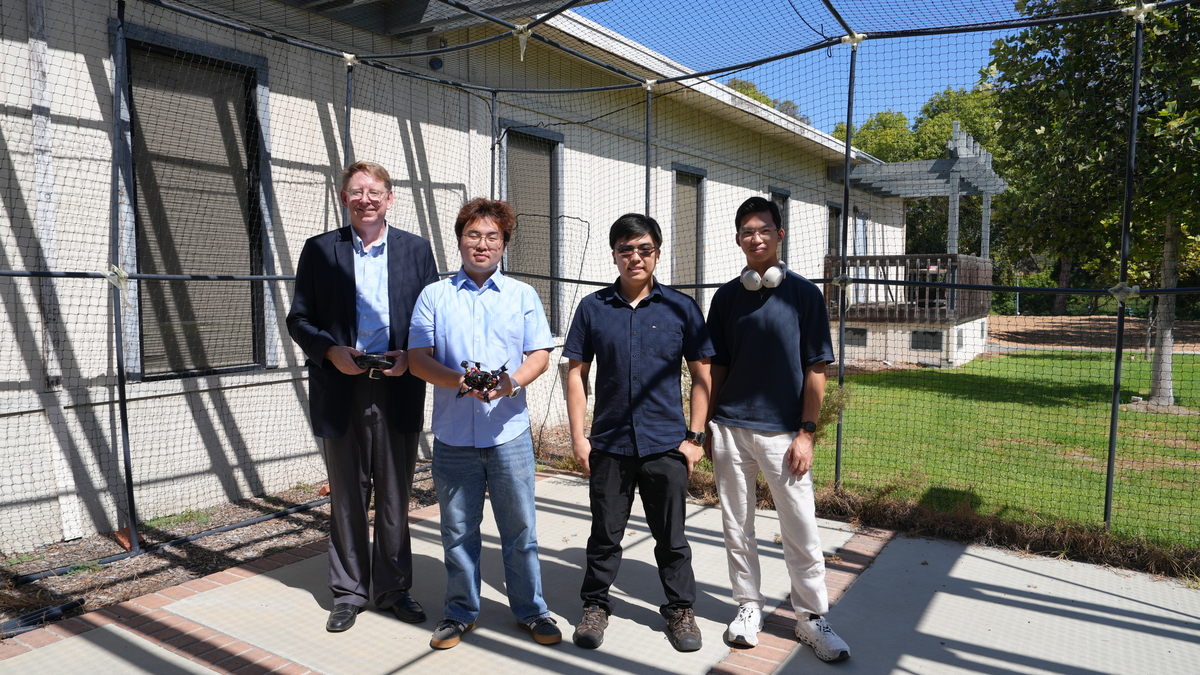
Peter Burke's EECS 195 Drones Course
Meanwhile, in his popular EECS 195 class, Burke teaches students how to build, fly and program that Guinness Award-winning drone for autonomous missions. They learn about all the drone’s components: the batteries, chemistry, motors, magnetics, GPS, wireless communications, circuitry, and control theory. They also learn about autonomy — a highly marketable skill. These skills are transferable to drones of any size and EV vehicles.
Peter Burke is innovating the newest drone technology and training students to be fluent in it. As for being on the ground as a professor, “It's the best job in the world,” Burke said. “You get to push the frontiers of human knowledge, interact with young people that are enthusiastic and intelligent. I wouldn't trade it for any other job.”
- Natalie Tso