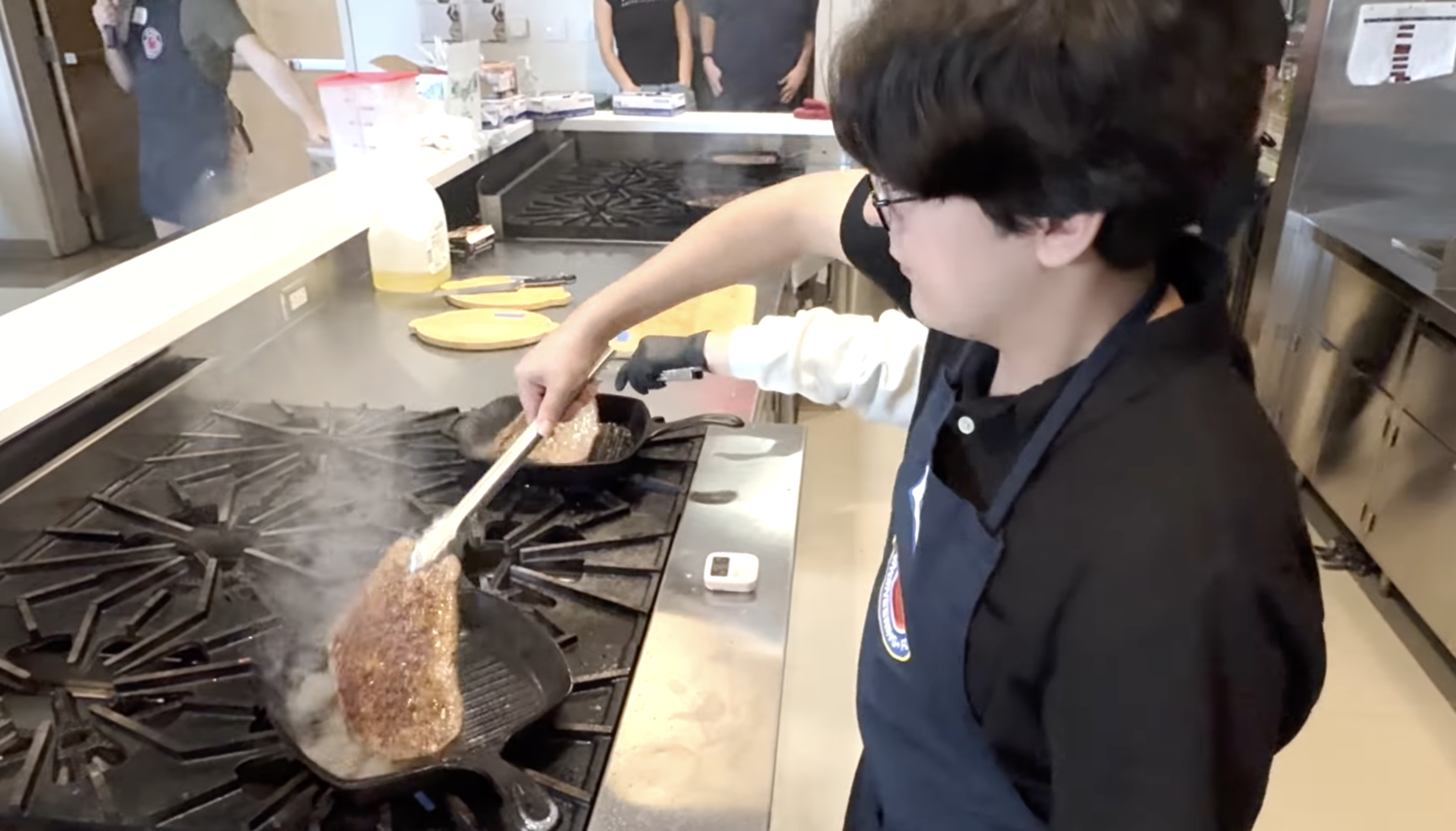
The classroom for Ty Christoff-Tempesta’s Edible Materials: Lab to Table course (MSE 48) does not resemble any other in the UC Irvine School of Engineering. Instead of a lab, students are in the kitchen, and steak, lava cakes, and cookies are on the menu.
Christoff-Tempesta, an assistant professor of materials science and engineering (MSE), combined his research specialty — organic materials — with his love of cooking. Now he’s spreading that joy to his students.
“This class was really inspired by two passions of mine. My research group studies organic materials, which are carbon-based materials, and food is also a carbon-based material,” he said. “The second personal passion of mine is cooking.”
His lab specializes in designing new molecules and linking them together to construct new materials for applications in sustainability and health. Among his interests are building replacements for plastics with better end-of-life options than the materials we have today, and he received a University of California Early Career Faculty Research Excellence Award to support that research. His group is also looking at how to design stable versions of materials inspired by cell membranes for water treatment, medicine, and beyond.
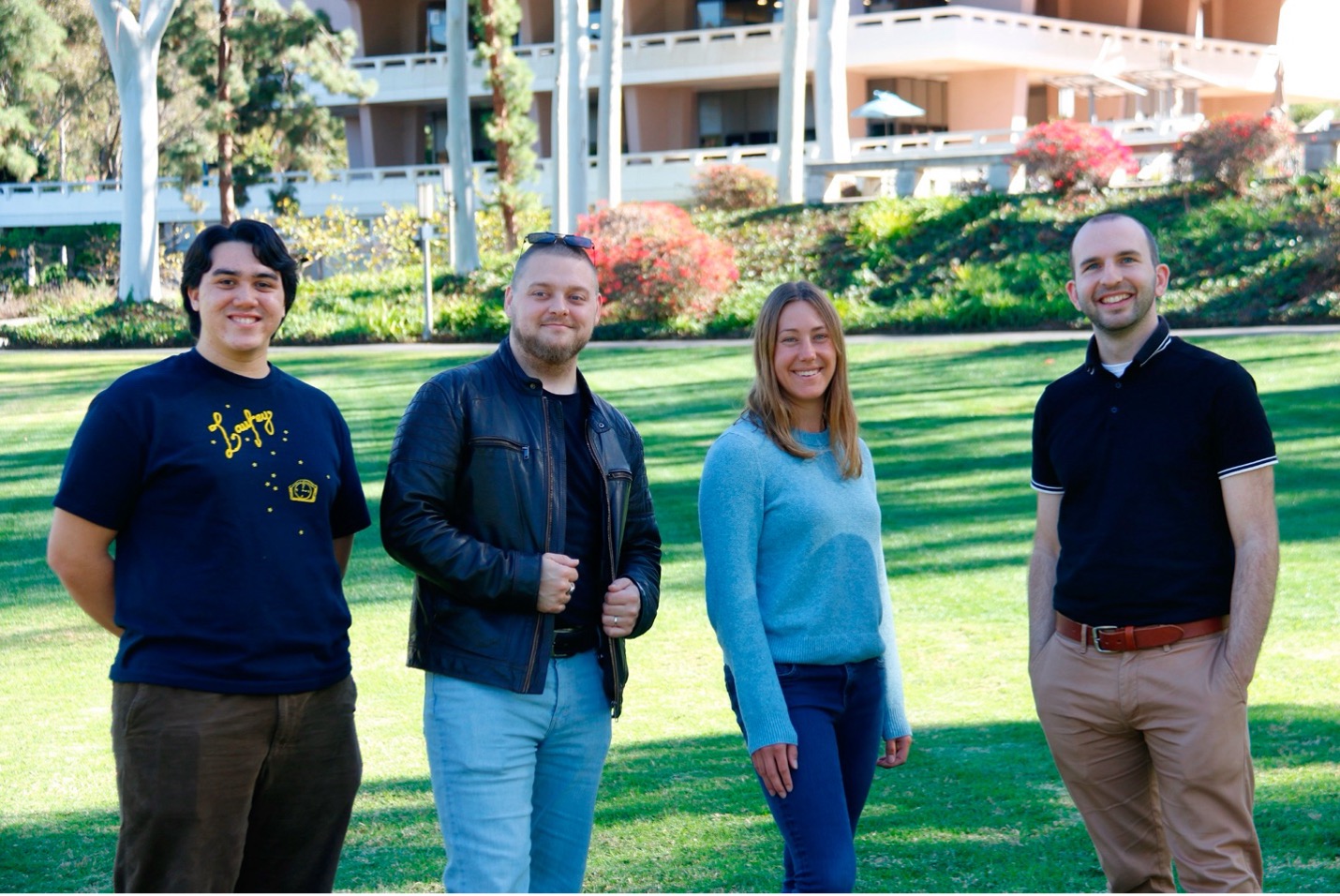
Ty Christoff-Tempesta (right) with his group’s Ph.D. students, from left, Victor Agbayani, Egor Novikov, and Quincy Spitzer
Back in the classroom, students participate in demos about the building blocks of food, the movement of heat and molecules during cooking, and how enzymes transform food. Many of these classes take place in the demonstration kitchen at the Anteater Recreation Center.
During a kitchen demonstration on heat diffusion, students baked lava cakes and seared steak to see what method and time frame led to the best results. The class compared mathematical predictions to real-life results on how long it takes to get the perfect texture for a molten lava cake, finding that 12 minutes was the perfect time to get a set outside and a gooey interior. Students also compared steaks made through common home and restaurant techniques, from sous vide to grilling, with different cooking times. The class found that flipping steak every 15 seconds on a grill led to the best medium rare texture by forming a desirable crust on the outside without overcooking the inside.
As a special treat, three guests visited the course last quarter: Monika Stout, the professional baker behind the Netflix shows Is it Cake? and Nailed It!; Jamie Gwen, a television chef and Cutthroat Kitchen winner; and Gus Castillo, founder and CEO of Pinto Robotics, a food robotics start-up.
Open to all UCI students, the lessons have applications across disciplines and pastimes. “I think this class is really special because usually you just read and learn about macromolecules, like proteins, lipids, and carbohydrates,” said materials science and engineering major Dominic Contreras. “In this class you actually take that knowledge, and you see how it interacts in a real time environment.”
“It's a fun way to incorporate engineering fundamentals into a fun hobby, like cooking,” said material sciences and engineering student Ivette Morales.
Christoff-Tempesta’s fondness for cooking stems from his childhood. “It was a way that my mom and I bonded growing up, so it’s been an interest for a long time,” he said. “Going through college, stress baking was a way to stay happy and balanced.”
He hopes the class will help students see how materials science relates to their lives and help them become better cooks in the process. “I think students are getting a bit of a hunger for science and a way to sate their own hunger,” he said.
- Natalie Tso