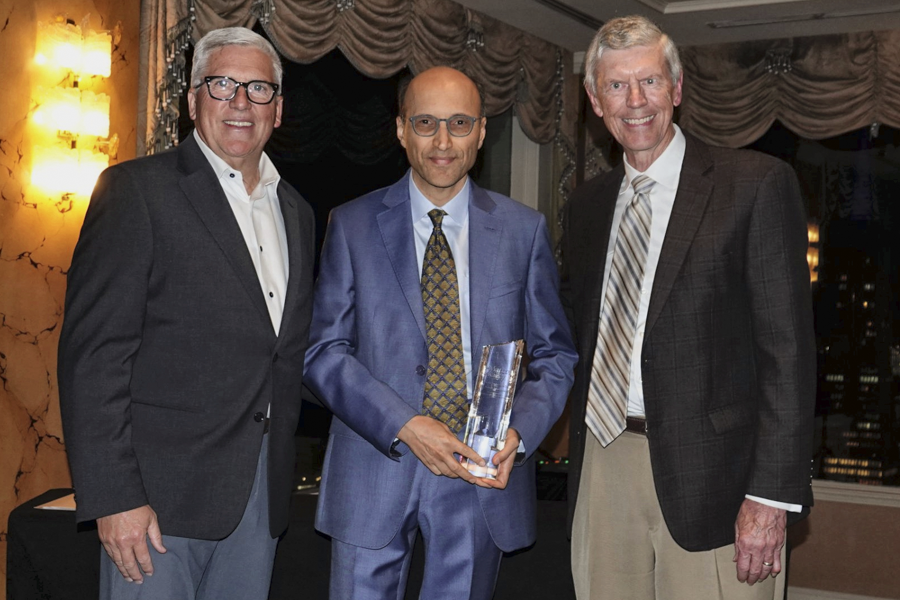
Hamid Jafarkhani, a distinguished professor of electrical engineering and computer science at UC Irvine, has received the 2026 Marconi Award for Innovation in Wireless Communications.
The award recognizes Jafarkhani’s contributions to wireless technology, including his co-invention of space-time block coding, a technique that helps multiple antennas transmit information reliably. His work helped establish foundations for cellular networks and Wi-Fi standards used by billions of devices worldwide.
Space-time block coding uses multiple antennas to transmit information in a coordinated way, helping receivers recover data more reliably. Limited-feedback MIMO enables higher throughput and reliability by using receiver-side channel information for transmitter adaptation. They address a fundamental challenge of wireless communication: Signals can weaken or become distorted as they travel.
Jafarkhani developed the technology with colleagues while working at AT&T Labs Research, Broadcom, and UCI. Since joining UCI in 2001, he has continued to advance wireless communications through research on multiple-antenna and reconfigurable-antenna systems. His work spans 52 patents, a book and more than 150 journal articles.
“Very few researchers have made such wide-ranging contributions to the birth of the mobile wireless connectivity that we now take for granted,” said Lee A. Swindlehurst, distinguished professor and chair in the Samueli School of Engineering.
Jafarkhani is among the inaugural recipients of the Marconi Society’s Institute Awards, which recognize technical achievement and real-world impact in artificial intelligence, internet resilience and advanced wireless technology. The recipients were honored Nov. 5 at the Marconi Institute Forums in San Francisco.
“It is an honor to receive this award and to be recognized alongside researchers whose work is helping people connect. I’m grateful to my colleagues, postdocs and students, whose collaboration has made this research possible, and I look forward to continuing to explore the future of wireless communications.”
- Paul McQuiston