Department of Materials Science and Engineering
NSF Graduate Research Fellows
 Iris Fu (2012) is working with professor Hung Nguyen on elucidating detailed molecular-level
mechanisms by which peptide-based conjugates are self-assembled into nanostructures
as hydrogel for tissue engineering or encapsulating nanoparticles for gene delivery
via molecular dynamics simulations.
Iris Fu (2012) is working with professor Hung Nguyen on elucidating detailed molecular-level
mechanisms by which peptide-based conjugates are self-assembled into nanostructures
as hydrogel for tissue engineering or encapsulating nanoparticles for gene delivery
via molecular dynamics simulations.  Julius Edson (2013) is working with professor Young Jik Kwon on the synthesis and characterization
of natural materials that can be used as antimicrobial materials. These materials
can also be used as non- viral vectors for applications in gene therapy.
Julius Edson (2013) is working with professor Young Jik Kwon on the synthesis and characterization
of natural materials that can be used as antimicrobial materials. These materials
can also be used as non- viral vectors for applications in gene therapy.
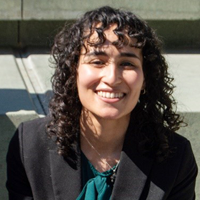 Salma El-Azab (2021) is working on entropy stabilized oxides, a special type of ceramic that displays
unique properties due to their composition under the guidance of Professor Julie Schoenung.
She investigates if these ceramics display useful transformation superplasticity,
which would make it easier to manufacture and recycle otherwise brittle material.
Salma El-Azab (2021) is working on entropy stabilized oxides, a special type of ceramic that displays
unique properties due to their composition under the guidance of Professor Julie Schoenung.
She investigates if these ceramics display useful transformation superplasticity,
which would make it easier to manufacture and recycle otherwise brittle material.
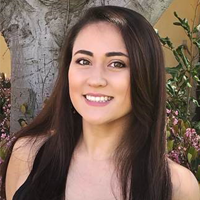 Sierra Gross (2020) is working with professor Ali Mohraz in studying energy storage technologies
and focuses on the effects of morphology and chemistry on these technologies, specifically,
bijel-derived systems that are scalable and have proven advantageous in energy applications.
Sierra Gross (2020) is working with professor Ali Mohraz in studying energy storage technologies
and focuses on the effects of morphology and chemistry on these technologies, specifically,
bijel-derived systems that are scalable and have proven advantageous in energy applications.
 Dominique Ingato (2013) is working on developing safe and efficient non-viral gene delivery vehicles
under the guidance of associate professor Young Jik Kwon. She focuses on nanotheranostics
– the integration of diagnostic and therapeutic function in one system using nanotechnology.
Dominique Ingato (2013) is working on developing safe and efficient non-viral gene delivery vehicles
under the guidance of associate professor Young Jik Kwon. She focuses on nanotheranostics
– the integration of diagnostic and therapeutic function in one system using nanotechnology.
 Nicole Ing (2013) is working with professor Allon Hochbaum to study bacterial communities that
control the flow of electricity through nanoscale protein- based wires. These bacteria
and their conductive appendages are key to understanding the role microbes in geochemical
cycles and are promising as active materials in hybrid bio-inorganic renewable energy
technologies, from fuel cells to solar power.
Nicole Ing (2013) is working with professor Allon Hochbaum to study bacterial communities that
control the flow of electricity through nanoscale protein- based wires. These bacteria
and their conductive appendages are key to understanding the role microbes in geochemical
cycles and are promising as active materials in hybrid bio-inorganic renewable energy
technologies, from fuel cells to solar power.
 Adrian Garcia (2014) is working with professor Regina Ragan on the control of graphene layers through
metal alloys onto interesting substrates. This is an integral component of the next
generation of high-energy density super- capacitors, carbon micro- electromechanical
devices, and graphene applications in general.
Adrian Garcia (2014) is working with professor Regina Ragan on the control of graphene layers through
metal alloys onto interesting substrates. This is an integral component of the next
generation of high-energy density super- capacitors, carbon micro- electromechanical
devices, and graphene applications in general.
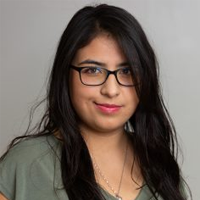 Jenny Martinez (2020) is a materials science and engineering graduate student working with professor
William Bowman on Ca-based nanoparticles with potential to capture CO2 from the atmosphere.
Jenny Martinez (2020) is a materials science and engineering graduate student working with professor
William Bowman on Ca-based nanoparticles with potential to capture CO2 from the atmosphere.
 Quynh Vo (2014) is working in the labs of professor Hung Nguyen and Prof. Mikael Nilsson.
Vo’s research uses molecular dynamics simulations in conjunction with experimental
work to clarify the processes involved in solvent extraction systems. This could improve
extraction efficiency of radioactive materials from spent nuclear fuel.
Quynh Vo (2014) is working in the labs of professor Hung Nguyen and Prof. Mikael Nilsson.
Vo’s research uses molecular dynamics simulations in conjunction with experimental
work to clarify the processes involved in solvent extraction systems. This could improve
extraction efficiency of radioactive materials from spent nuclear fuel.
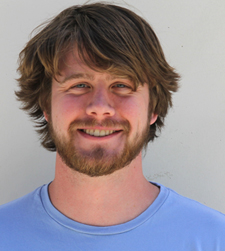 Rylan Kautz (2015), a materials science graduate student, fabricates reflectin films, analyzing
their use as biological substrates for cell adhesion and growth. With reflectin's
unique material properties, this work could introduce new types of tissue scaffolds
and bioelectronic devices. His primary adviser is chemical engineering and materials
science professor Alon Gorodetsky, but he also collaborates with Francesco Tombola’s
physiology and biophysics lab, and Lisa Flanagan’s neurology lab.
Rylan Kautz (2015), a materials science graduate student, fabricates reflectin films, analyzing
their use as biological substrates for cell adhesion and growth. With reflectin's
unique material properties, this work could introduce new types of tissue scaffolds
and bioelectronic devices. His primary adviser is chemical engineering and materials
science professor Alon Gorodetsky, but he also collaborates with Francesco Tombola’s
physiology and biophysics lab, and Lisa Flanagan’s neurology lab.
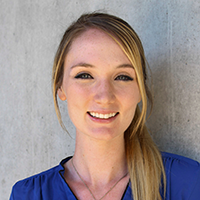 Melissa Thone (2016), a chemical and biochemical engineering major, under professor Young Jik Kwon,
is researching the use of extracellular vesicles (EVs) as therapeutic and diagnostic
(nanotheranostic) platforms for cancer therapy. EVs have properties that could make
them better drug delivery vehicles than current systems, which would allow for more
effective treatment of a multitude of diseases.
Melissa Thone (2016), a chemical and biochemical engineering major, under professor Young Jik Kwon,
is researching the use of extracellular vesicles (EVs) as therapeutic and diagnostic
(nanotheranostic) platforms for cancer therapy. EVs have properties that could make
them better drug delivery vehicles than current systems, which would allow for more
effective treatment of a multitude of diseases.
 Chloe Groome (2017) is working with professor Regina Ragan on computational approaches to investigating
how defects in graphene can be tailored to stabilize and improve the performance of
earth-abundant single-atom catalysts. Single-atom catalyst systems maximize catalytic
performance while minimizing or completely replacing the use of expensive metals such
as platinum.
Chloe Groome (2017) is working with professor Regina Ragan on computational approaches to investigating
how defects in graphene can be tailored to stabilize and improve the performance of
earth-abundant single-atom catalysts. Single-atom catalyst systems maximize catalytic
performance while minimizing or completely replacing the use of expensive metals such
as platinum.
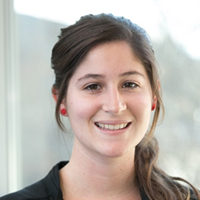 Sarah Maxel (2018) works with adviser Han Li, chemical engineering and materials science assistant
professor, to engineer biological cells that can convert renewable resources to useful
chemicals like fuels, industrial commodities and pharmaceutical compounds. She uses
synthetic biology and protein engineering to construct unnatural metabolic pathways
that can help solve a range of metabolic engineering problems.
Sarah Maxel (2018) works with adviser Han Li, chemical engineering and materials science assistant
professor, to engineer biological cells that can convert renewable resources to useful
chemicals like fuels, industrial commodities and pharmaceutical compounds. She uses
synthetic biology and protein engineering to construct unnatural metabolic pathways
that can help solve a range of metabolic engineering problems.
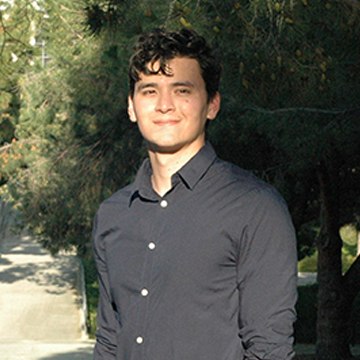 Eric Yoshida (2023) is working with Kai He, assistant professor of materials science and engineering,
on developing batteries that use a solid-state electrolyte that has greater energy
storage potential than the liquid-state electrolyte currently used. He analyzes the
space-charge layer in solid electrolytes, the layer formed when two materials cannot
achieve neutrality, using Transmission Electron Microscopes He also researches how
synthesizing solid electrolyte materials can be more energy efficient to make industrial
production environmentally sustainable.
Eric Yoshida (2023) is working with Kai He, assistant professor of materials science and engineering,
on developing batteries that use a solid-state electrolyte that has greater energy
storage potential than the liquid-state electrolyte currently used. He analyzes the
space-charge layer in solid electrolytes, the layer formed when two materials cannot
achieve neutrality, using Transmission Electron Microscopes He also researches how
synthesizing solid electrolyte materials can be more energy efficient to make industrial
production environmentally sustainable.