Spring 2015
 Chair's Message | BMES 2015 | Outstanding Student Highlights | Faculty Accolades | Focus on Research
FROM THE CHAIR
 Dear Friends of BME at UCI,
As UCI launches its 50th anniversary celebrations, "Bright Past. Brilliant Future"
is the tagline seen all around campus. This certainly reflects BME's history and its
plans for a shining future. The half-century milestone also marks a year of new leadership
- new Chancellor Howard Gillman, recently announced Provost and Executive Vice Chancellor
Enrique Lavernia, new Vice Chancellor for Health Sciences and School of Medicine Dean
Dr. Howard Federoff, and relatively new Chao Comprehensive Cancer Center Director
Dr. Richard A. Van Etten. We are excited to welcome these new leaders and will engage
them as we strategize the BME department's next steps to pursue cutting-edge opportunities
that combine engineering and technological approaches to diagnostics and disease treatments.
We will continue to remind them that BME stands ready to be the primary bridge between
medicine and engineering, between fundamental research and translational research,
and from traditional medicine to personalized and individualized medicine. The future
of medicine relies on strong partnerships, and BME at UCI is prepared to take on the
challenges necessary to ensure the wellbeing of future generations.
This newsletter is about the people we cherish at BME/UCI: their stories, their aspirations,
their visions and their achievements. In this issue, you will read about our efforts
and accomplishments; outstanding students; faculty accolades, including the Feld Biophotonics
Award received by BLI Director Bruce Tromberg; and many exciting new research projects.
Sincerely,
Abe Lee, William J. Link Professor and Chair, BME at UCI
BMES 2015
UCI BME to Host Dessert Reception
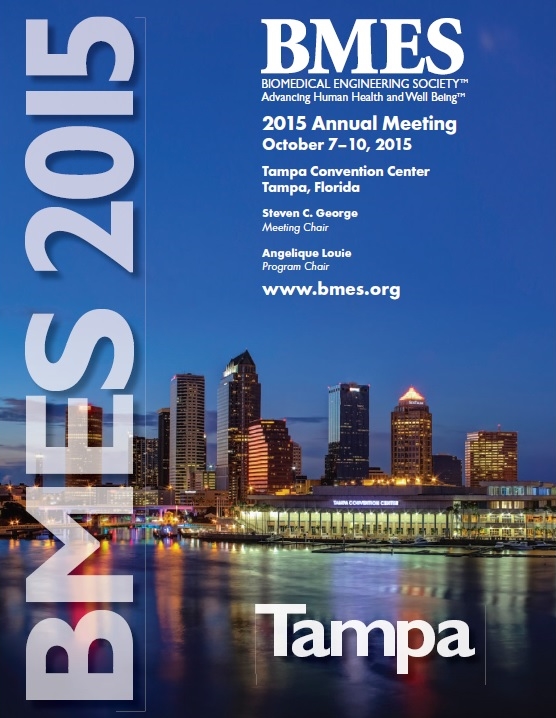
Thousands of members and guests will participate in the annual Biomedical Engineering Society (BMES) conference in Tampa, Fla., Oct. 6-10, 2015. Each year, the conference offers more than 2,000
scientific presentations, a career fair, a robust exhibit hall and various networking
and interview opportunities.
This year, UCI Biomedical Engineering will have its largest presence at the conference.
Many of our students and faculty will participate in workshops, seminars and poster
sessions, and we will have a large booth where prospective students and researchers
can meet one-on-one with our esteemed faculty, learn about our various research thrusts
and discover, firsthand, why ours is an outstanding program. UCI BME will also host
its annual Dessert Bar and Reception, where our special guests can network in an intellectual
(and entertaining) environment.
Founded in 1968, BMES is the largest and most respected professional society for engineering
and bioengineering with over 6,500 members. The organization's mission is to build
and support the biomedical engineering community locally, nationally and internationally,
with activities designed to communicate recent advances, discoveries and inventions;
promote education and professional development; and integrate the perspectives of
the academic, medical, governmental and business sectors.
OUTSTANDING STUDENT HIGHLIGHTS

Two Graduate Students Receive NSF Graduate Research Fellowships
Biomedical engineering graduate students Christian Crouzet and Neto Sosa have been named recipients of the 2015 Graduate Research Fellowship award from the National Science Foundation (NSF). The Graduate Research Fellowship Program (GRFP) offers support directly to graduate students selected through a national competition, providing three years of financial support within a five-year fellowship period for graduate study that leads to a research-based master's or doctoral degree in science or engineering. Former NSF Fellows include numerous individuals who have made transformative breakthroughs in science and engineering, become leaders in their chosen careers, and been honored as Nobel laureates. Crouzet works in the lab of Bernard Choi; Sosa works in the lab of pharmaceutical sciences professor Weian Zhou.
BME Graduate Student Earns Faculty for the Future Award

Biomedical engineering doctoral student Neha Garg received the 2015 Schlumberger Foundation Future Faculty award. The program supports
women scientists from developing countries through grants that enable them to pursue
doctoral and postdoctoral studies in scientific and engineering disciplines at leading
universities worldwide.
Garg works on the separation and enrichment of circulating tumor cells (CTCs) using
acoustics in a microfluidic device. Because the CTCs are much larger than the other
blood cells, they can be separated using a lateral cavity acoustic transducers device.
Garg says the device also can be used to separate impurities from water. She works
in the lab of Professor Abe Lee. Read more >>
Doctoral Candidate Wins Optics in Cardiology Best Poster Award

Doctoral candidate Jiawen Li and her team were given the Best Technical Poster award at the 2015 Optics in Cardiology Conference. The poster introduces an ultra-fast IVUS-OCT imaging system that provides safer and more accurate diagnosis than any commercially available technology. This system demonstrated its superior diagnostic capabilities in tests in five live rabbits.
Chancellor's Club Fellowship Awarded

Engineering graduate student researcher Sophia Lin was selected to be a Chancellor's Club Fund for Excellence Fellow. Lin works in the lab of Associate Professor Michelle Khine. Lin’s research involves developing low-cost, point-of-care diagnostic devices for disease detection. She is using shrink wrap film to make highly wrinkled surfaces that enhance the ability to detect biomolecules that are indicative of diseases. By enhancing the ability to detect these biomolecules, she hopes to potentially detect diseases at an earlier stage, leading to earlier treatment and better prognoses. These fellowships are awarded to UCI's best graduate students, who also show great promise as future leaders.
BME Graduate Student Selected for Artiman 2015 B.E.T.A. Class

Biomedical engineering graduate student Jonathan Pegan was named to the Artiman Ventures' Biology, Economics, Technology, and the Arts (B.E.T.A.) 2015 class. A doctoral student in Michelle Khine's lab, Pegan is focused on developing
wearable technology for health monitoring applications. By using scalable manufacturing
methods to make these stretchable sensors, he hopes to translate his research into
a commercial reality and has started a company called TinyKicks. The B.E.T.A. program
helps a group of promising researchers from diverse educational backgrounds get a
head start on their careers by connecting them with Silicon Valley business leaders,
investors, advisers and entrepreneurs.
FACULTY AND POSTDOC ACCOLADES
Laser Institute Director Wins Optical Society Award

Beckman Laser Institute & Medical Clinic Director Bruce Tromberg has received the Michael S. Feld Biophotonics Award from The Optical Society, the leading professional association in optics and photonics. One of 15 prestigious awards bestowed by the society in 2015, it recognizes individuals for their innovative and influential contributions to the field of biophotonics. A UCI professor of surgery and biomedical engineering, Tromberg runs BLI's Laser Microbeam & Medical Program. He has pioneered methods for optical spectroscopy and imaging, and has applied these technologies to the discovery and validation of imaging methods for detecting disease and improving therapeutic outcomes for patients. He helped create diffuse optical spectroscopy and imaging technology that is being used in a portable scanner to detect breast cancer and that produces images based on tumor composition. Oncologists can compare images of a tumor before and after chemotherapy to determine if it's shrinking. Now in clinical trials at BLI, the scanner could become an integral part of breast cancer treatment.
Michelle Khine Elected into the College of Fellows at AIMBE

Congratulations to biomedical engineering Associate Professor Michelle Khine for her election to the College of Fellows of the American Institute for Medical
and Biological Engineering, headquartered in Washington D.C. This honor represents
the top two percent of medical and biological engineers in the country. Khine was
nominated, reviewed and elected by peers and members of the College of Fellows for
outstanding contributions to developing a low-cost diagnostic technology enabling
new biomedical health research and applications.
Khine also delivered the keynote speech at the 2015 Orange County Science and Engineering
Fair (OCSEF), an institution that has been committed to promoting science and engineering
in Orange County since 1955.
2015 Robert Newcomb Interdisciplinary Team Science Award Announced
The UC Irvine Multimodality Intravascular Imaging Team was awarded the 2015 Robert
Newcomb Interdisciplinary Team Science Award. This honor was established to recognize
individuals who have played a formative role in bringing together teams of researchers
from diverse trans-, multi-, and interdisciplinary backgrounds in studies and projects
that have advanced biomedical and clinical research.
The Intravascular Imaging Team is a transdisciplinary collaboration of three groups
of investigators from different disciplines: OCT group (Zhongping Chen from UCI's Department of Biomedical Engineering); IVUS group (Qifa Zhou from the
NIH Transducer Resource Center at USC); and Interventional Cardiology group (Pranav
Patel from the Department of Medicine and Division of Cardiology at UCI). The team
evolved from a shared goal to develop an integrated intravascular imaging modality
that can detect, diagnose and manage vulnerable plaques to prevent the lethal consequences
of atherosclerosis. The team has significant synergies and complementary non-overlapping
skills. Together they have addressed the problem of designing and constructing a new
intravascular imaging platform that integrates intravascular ultrasound (IVUS), optical
coherence tomography (OCT), photoacoustic tomography (PAT), and acoustic radiation
force optical coherence elastography (ARF-OCE).
Zoran Nenadic Accepts $1 Million Grant from National Science Foundation
 Zoran Nenadic, associate professor of biomedical engineering, has received a 4-year $1 million
award from the National Science Foundation to develop a cyber-physical system (CPS)
that can potentially restore mobility in those suffering from paralysis due to spinal
cord injury or stroke. The CPS is envisioned as a fully implantable brain-computer
interface system that can directly link the brain with a lower-extremity prosthesis,
thus bypassing neurological damage and enabling intuitive brain-driven control of
ambulation. It will consist of a fully implantable brain recording device that relies
on a revolutionary low-power design so as to minimize heat dissipation and potential
brain damage. In addition, the system will incorporate an internal signal-processing
unit capable of analyzing brain waves and wirelessly transmitting commands to a prosthesis
in order to actuate walking. The award will be used to develop and test a benchtop
version of the CPS. This is a joint project with Payam Heydari (UCI electrical engineering
and computer science), Dr. An H. Do (UCI neurology), and Dr. Charles Y. Liu (neurosurgery,
University of Southern California).
Zoran Nenadic, associate professor of biomedical engineering, has received a 4-year $1 million
award from the National Science Foundation to develop a cyber-physical system (CPS)
that can potentially restore mobility in those suffering from paralysis due to spinal
cord injury or stroke. The CPS is envisioned as a fully implantable brain-computer
interface system that can directly link the brain with a lower-extremity prosthesis,
thus bypassing neurological damage and enabling intuitive brain-driven control of
ambulation. It will consist of a fully implantable brain recording device that relies
on a revolutionary low-power design so as to minimize heat dissipation and potential
brain damage. In addition, the system will incorporate an internal signal-processing
unit capable of analyzing brain waves and wirelessly transmitting commands to a prosthesis
in order to actuate walking. The award will be used to develop and test a benchtop
version of the CPS. This is a joint project with Payam Heydari (UCI electrical engineering
and computer science), Dr. An H. Do (UCI neurology), and Dr. Charles Y. Liu (neurosurgery,
University of Southern California).
Technology Development Awards Recognize Two BME Faculty

Samueli School researchers have won two of just four $200,000 technology development
awards from the University of California Center for Accelerated Innovation (UC CAI).
The UC CAI, a collaboration of all five UC medical campuses, is focused on advancing
promising medical/health technologies from research to commercialization. This year,
out of 48 pre-applications submitted for technologies addressing heart, lung and blood
diseases, 24 were invited to submit full applications and just four grants systemwide
were awarded.
Elliot Botvinick, biomedical engineering associate professor, is developing a microchip device to
continuously monitor lactate concentration in critically ill patients. While lactate
monitoring has been shown to significantly improve outcomes in trauma and sepsis patients,
current technologies require the logistical burdens of serial monitoring and/or lab
panels. This real-time measurement device can return results continuously, helping
doctors better achieve goal-directed treatment.
Arash Kheradvar, biomedical engineering associate professor, is constructing a patient-specific self-regenerative
hybrid heart valve. The valve, comprising a super-elastic mesh, will have the potential
to last a lifetime. It will be tightly enclosed by multiple layers of the patient's
muscle and cells, allowing it to immediately integrate into the heart and regenerate
as if it were a natural organ.
FOCUS ON RESEARCH
Using Microtsunamis to Study Cellular Mechanotransduction
 Many pathological conditions including hypertension, osteoarthritis and tumor metastasis
have been linked to the dysregulation of biochemical pathways that modulate cell behavior
based on its local mechanical microenvironment. Unfortunately, no methods exist that
can rapidly identify molecules that can interfere with these cellular mechanotransduction
pathways. In "High-throughput optical screening of cellular mechanotransduction" by
J. L. Compton, J. C. Luo, H. Ma, E. Botvinick and V. Venugopalan (Nature Photonics, published online August 3, 2014), the authors introduce an optical
platform that combines pulsed laser irradiation and dynamic fluorescence imaging for
rapid, high-throughput screening of exogenous molecules that affect cellular mechanotransduction.
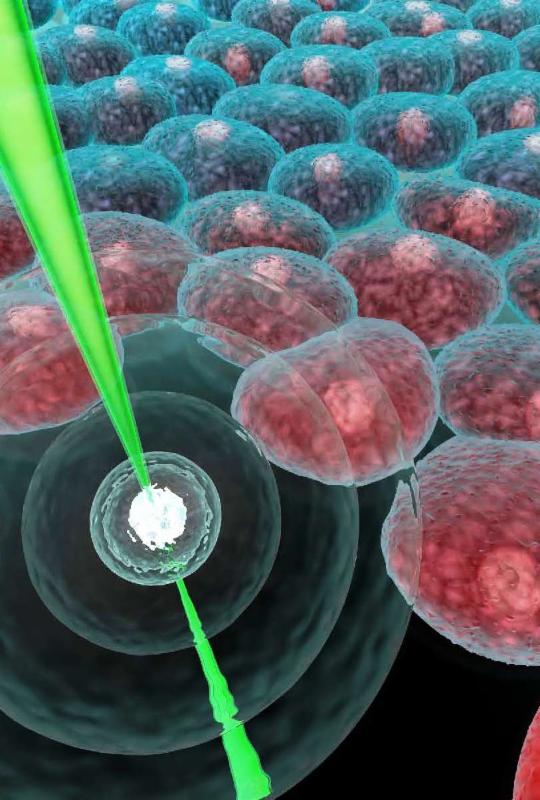
The method initiates mechanotransduction in adherent cells using single laser-microbeam-generated
microcavitation bubbles without requiring flow chambers or microfluidics. These microcavitation
bubbles expose adherent cells to a microtsunami, a transient microscale burst of hydrodynamic
shear stress, which can stimulate primary human endothelial cells over areas approaching
1mm2.
Many pathological conditions including hypertension, osteoarthritis and tumor metastasis
have been linked to the dysregulation of biochemical pathways that modulate cell behavior
based on its local mechanical microenvironment. Unfortunately, no methods exist that
can rapidly identify molecules that can interfere with these cellular mechanotransduction
pathways. In "High-throughput optical screening of cellular mechanotransduction" by
J. L. Compton, J. C. Luo, H. Ma, E. Botvinick and V. Venugopalan (Nature Photonics, published online August 3, 2014), the authors introduce an optical
platform that combines pulsed laser irradiation and dynamic fluorescence imaging for
rapid, high-throughput screening of exogenous molecules that affect cellular mechanotransduction.
The method initiates mechanotransduction in adherent cells using single laser-microbeam-generated
microcavitation bubbles without requiring flow chambers or microfluidics. These microcavitation
bubbles expose adherent cells to a microtsunami, a transient microscale burst of hydrodynamic
shear stress, which can stimulate primary human endothelial cells over areas approaching
1mm2.
Current assays used for screening of small molecule libraries do not assess the ability
of these molecules to modulate cellular responses to mechanical cues. The authors
postulate the existence of classes of 'mechano-active' drugs that can target these
pathways: drugs that remain undiscovered because there is no practical method to implement
high-throughput screening. The results of numerous studies support the important role
of mechanotransduction in many vital processes, including tissue morphogenesis, stem
cell differentiation, vascular regulation and tumor metastasis. Moreover, there is
mounting evidence that disruptive mechanical cues and/or dysregulation of mechanotransduction
pathways play important roles in the initiation and/or progression of numerous diseases,
including atrial fibrillation, hypertension, osteoporosis, digestive diseases and
cancer.
Engineering in Medicine Topic of Dean's Distinguished Lecture

Dr. Roderic Pettigrew, director of the NIH's National Institute of Biomedical Imaging and Bioengineering
addressed the importance of merging life sciences, physical sciences and engineering
with medicine during a Samueli School Dean's Distinguished Lecture on April 7.
Citing rising healthcare costs combined with an aging population beset by chronic
illness, Pettigrew said there is a need, in the U.S. and globally, to integrate "engineering
into medicine, and medicine into engineering until all the boundaries vanish. It's
absolutely critical to the kind of innovation that will be needed to increase access,
provide higher quality care to more people, and do that with restrained costs."
Precision medicine, including precision diagnostics and therapeutics - what Pettigrew
called "precision theranostics" - is also a priority of the Obama administration,
Pettigrew said, adding that the NIH is "very active" in its quest to achieve this
vision.
This new paradigm is a more precise approach to healthcare based on better understanding
of the cell and the molecular mechanisms of disease, enabling treatment to be tailored
to individual patients, he said. "It's about precise measurement, precise diagnostics
and precise delivery based on that precision-based information."
Pettigrew lauded the role played by engineering in this collaborative approach to
medicine. "Engineering is central to driving advances in many areas to improve public
health," he said. "It's about improving our fundamental knowledge of how nature works
and using that knowledge to improve health with technologies that will allow us to
make diagnoses at point of care, and improve therapeutics so they're more specific,
more focused and targeted to the problem at hand."